The Bench Are Not Your Starters
Why a bigger cast doesn’t automatically mean a better show, and how to tell which of your characters are actually starting.
It’s football season, and whether you’re a sports fan or not, that means sports puns-a-plenty. You’d be surprised just how many are well-suited to TV writing craft, and today’s topic is no exception. The bench are not your starters. What does that mean? An ensemble cast can’t replace the need for rich, unique, fully developed characters.
Before we dive in, a quick reminder: the founding rates we opened dev|cut. with close September 30, and we move to standard pricing on October 1. If you lock in before then, that’s your rate for as long as you stay subscribed, with no expiry date. Just didn’t want the date to sneak up on anyone who’s been meaning to.
Shameless plug over… let’s go.
The Ensemble Trap
Here’s a pattern that shows up constantly in early-draft pilots, especially in the ensemble-heavy shows that are extremely popular to write (and produce) right now: the writer builds out a huge bench of characters, but none of them have any real depth or reason to be there beyond set dressing.
It makes sense why this happens. An ensemble feels safer than a tight core cast. If one character isn’t quite landing, you’ve got six others to lean on. If a relationship dynamic falls flat, there’s always another pairing to cut to. It’s the writing version of keeping your options open, and it feels like the cautious move. But it rarely is. Inevitably, thin characters, no matter how many there are, get found out.
The problem is that an audience can’t invest in six people the way they can invest in three or four. Attention is finite, and every page spent introducing character number seven, eight, nine, ten, is a page not spent making us care about characters one through four. What you get instead is a pilot that reads busy but doesn’t really build anyone. A show with plenty of cast and not much center.
The shows that get this right almost always do it in reverse order from how it feels safest. They earn a tight core cast first: characters we understand, want something specific for, and would follow into a second season on their own. That means leads whose choices actually drive the story rather than characters the plot happens around. Only once that core is doing real work does the bench get built out around it. The ensemble becomes something the core cast interacts with, not a replacement for finishing the job on your leads.
The Rose Bush Theory
Come with me on this one. I swear it’ll make sense, and more importantly, it goes beyond just saying “cut characters.”
Think about a rose bush. What do you see first? The roses. Kind of a no-duh, I know. But the blossoms are what grabs your eye and holds it. If you look longer, or closer, you start to notice the leaves, the thorns, the stems, the roots, the dirt underneath all of it. Every part of that plant matters. The roots and stems are doing real, load-bearing work, arguably more than the blossoms are, but without the blossoms out front doing the job of catching your attention in the first place, chances are you’d have walked right past the rest of the bush without ever registering it was there.
TV audiences work the same way. A whole ensemble of evenly thin characters, all sketched with roughly the same amount of detail, doesn’t read as rich. It reads as nothing in particular, because there’s no blossom telling the audience where to look first.
What a big ensemble needs isn’t for everyone to be equally vivid. That’s not possible, and it wouldn’t work if it were. What it needs is a small number of spotlighted characters doing the blossom’s job, pulling focus and giving the audience a throughline they can track and root for, while the rest of the cast does the stem-and-root work: connective tissue, texture, a reason the world feels lived-in. Both jobs matter. They’re just not the same job, and a script that tries to make every character do the blossom’s job ends up with a bush that’s all roots and no roses.
Who’s in the Starting Rotation?
None of this means your core cast has to be locked forever. The characters holding the spotlight can shift over a season, or across a series, without breaking anything we just said. This note is about something narrower: what a single episode actually needs to work.
Take a show like Game of Thrones. Massive cast, a dozen storylines running at once. Trying to meaningfully check in with every one of them in every episode would be a disaster, not because there isn’t enough time, but because spreading focus that thin makes everything feel equally minor. Nothing gets room to land. So the show doesn’t do that. A given episode picks its starters. Maybe this week it’s the Jaime and Brienne thread carrying real weight, alongside the Ramsay and Sansa thread. Other storylines might get touched, a scene here, a beat there, but the bulk of that hour’s attention goes to one or two threads and the handful of characters inside them.
Same logic, much lower stakes: The Big Bang Theory has seven series leads. Do all seven get equal screen time in every single episode? They don’t, and if they tried to, it would be exhausting to watch. Some episodes are a Sheldon-and-Leonard story with everyone else orbiting. Some are a Penny story. The full cast is available across the series. The starting lineup still gets picked fresh, episode by episode.
Starters or Benchwarmers? A Quick Test
Here’s a test to run on your own outline or latest draft. For any single episode, list out every named character who appears in it. Then, for each one, ask: if I cut this character out of this specific episode, does anything about the story actually change? That’s it. Yes, it’s simple, but it’s truly effective.
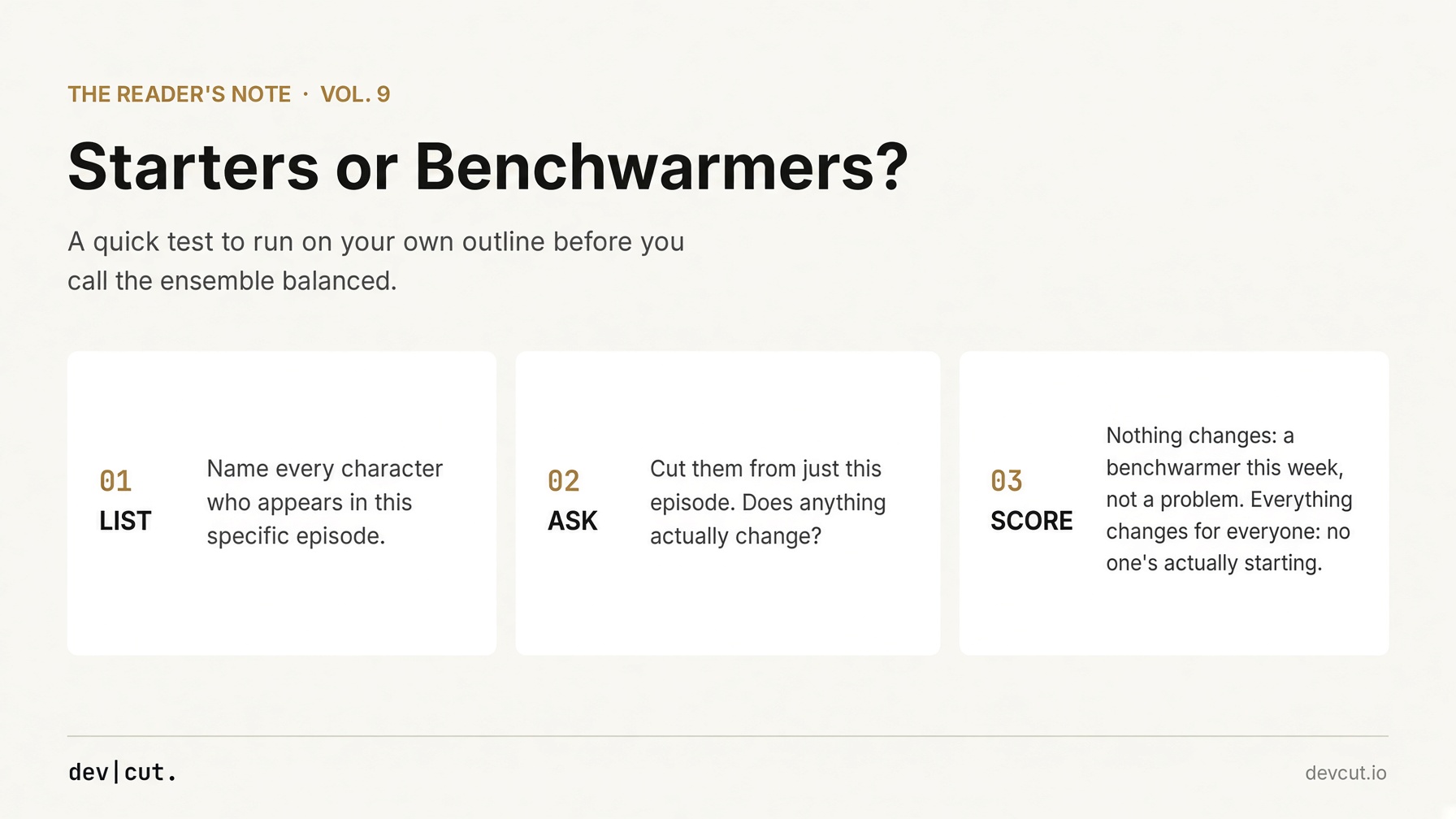
The test to see what kind of characters you’re creating.
If the honest answer is “nothing changes,” that character is a benchwarmer this episode. That’s not automatically a problem. Benchwarmers exist for a reason, and the same character might be a lead three episodes from now.
The other warning sign is the polar opposite result. If every character in your ensemble is getting real weight, real stakes, and real screen time all at once in a single episode, that’s usually not a sign of a rich ensemble. It’s a sign nobody’s actually that rose blossom, because you’re distributing attention evenly instead of directing it. A real starting rotation flexes. If yours never does, it isn’t one.
If You’re Producing or Optioning
This is the finding that shows up most often in early coverage on ensemble pilots. Not “too many characters” as a flat note, but “too many characters who are all doing the same job the lead should already be doing.” A crowded first episode isn’t really a crowding problem, it’s a commitment problem. The writer hasn’t yet decided who this show is really about, so the page hedges by giving everyone a little screen time instead of giving someone real weight.
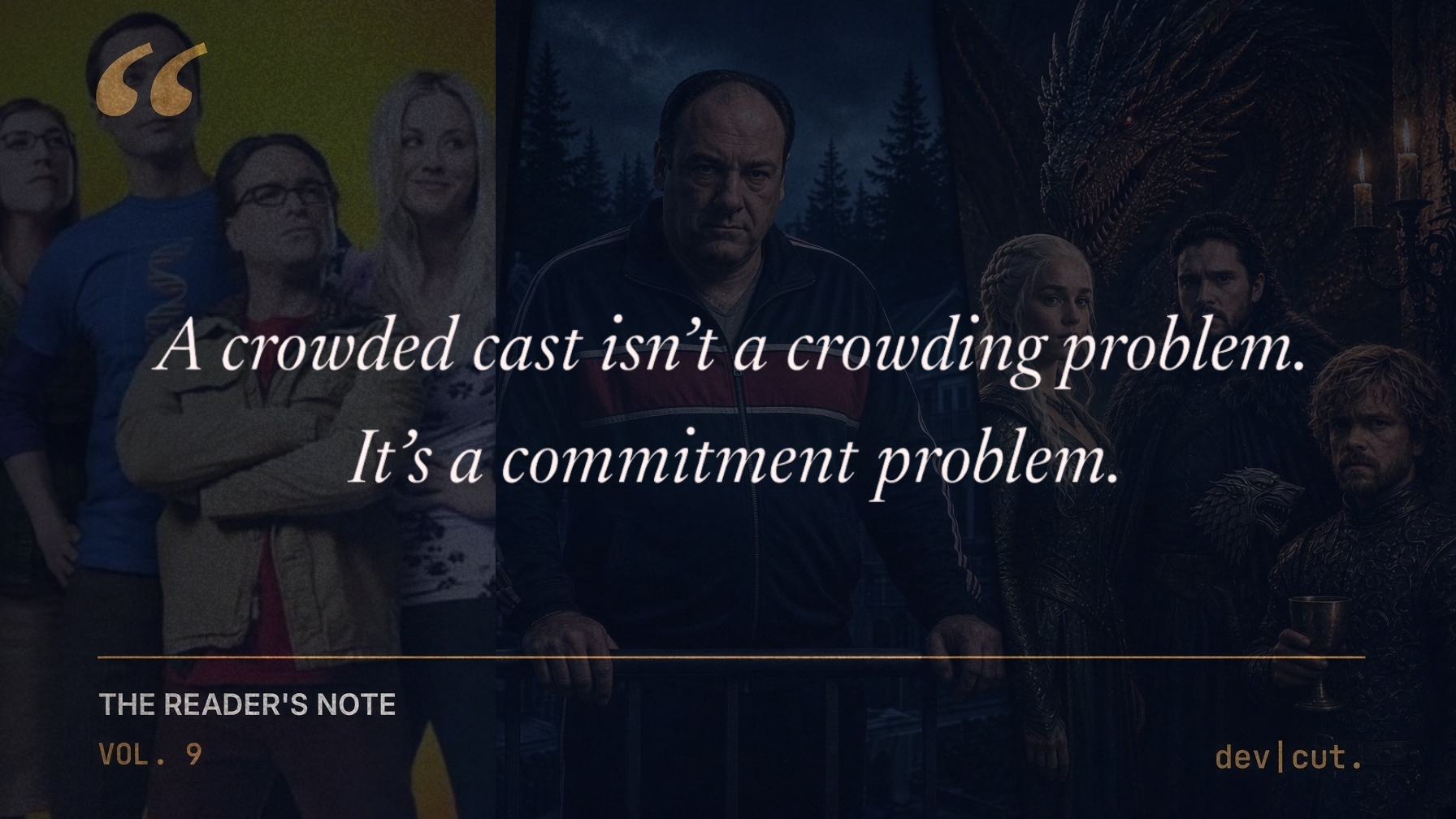
Without committing to a character (or a few), everyone else feels thin.
The fix, when we flag it, is almost never “cut characters.” It’s “decide who the core cast is, then let everyone else earn their way in around that decision.” A show can absolutely support a big ensemble later. It just has to survive on a small one first.
Why Coverage Should Be Looking for This
A pilot with a huge cast can look impressive on the page. All that scope, all that world. But scope isn’t the same thing as investment, and a reader can usually tell within the first ten pages whether a writer has committed to their core cast or is still hedging their bets across a dozen people.
That’s the read we try to give any ensemble script that comes through dev|cut.™: not “is the world big enough,” but “has the writer actually chosen who this show is about.” The bench matters. It’s just not the team.
If you want more of this — the craft breakdowns, the case studies, the occasional pilot that earns its whole ensemble — you know where to find us. Lots more to come.
Wondering whether your pilot has committed to its core cast? See coverage pricing — founding rates hold through September 30.
[Soon] The story continues… — Brian Hanford, Writer & Founder, dev|cut.™ · devcut.io
← Back to Blog