The 3-for-1 Trick Behind TV's Best Pilots
The difference between a pilot that opens strong and one that runs five seasons — for the writer, the development room, and the buyer.

The best pilots have one conceit that's doing three jobs at once.
A note from one of the recent beta reads keeps coming back to me.
Not a weakness. A strength. Actually, a big time strength… and a rare one. It's about a pilot conceit that isn't doing one job, it's doing three. All in the same single stroke, without any of them feeling bolted onto the others. So, enough teasing, let's get into what I'm talking about.
One Answer to Three Pilot Questions
The script: a sci-fi period thriller pilot.
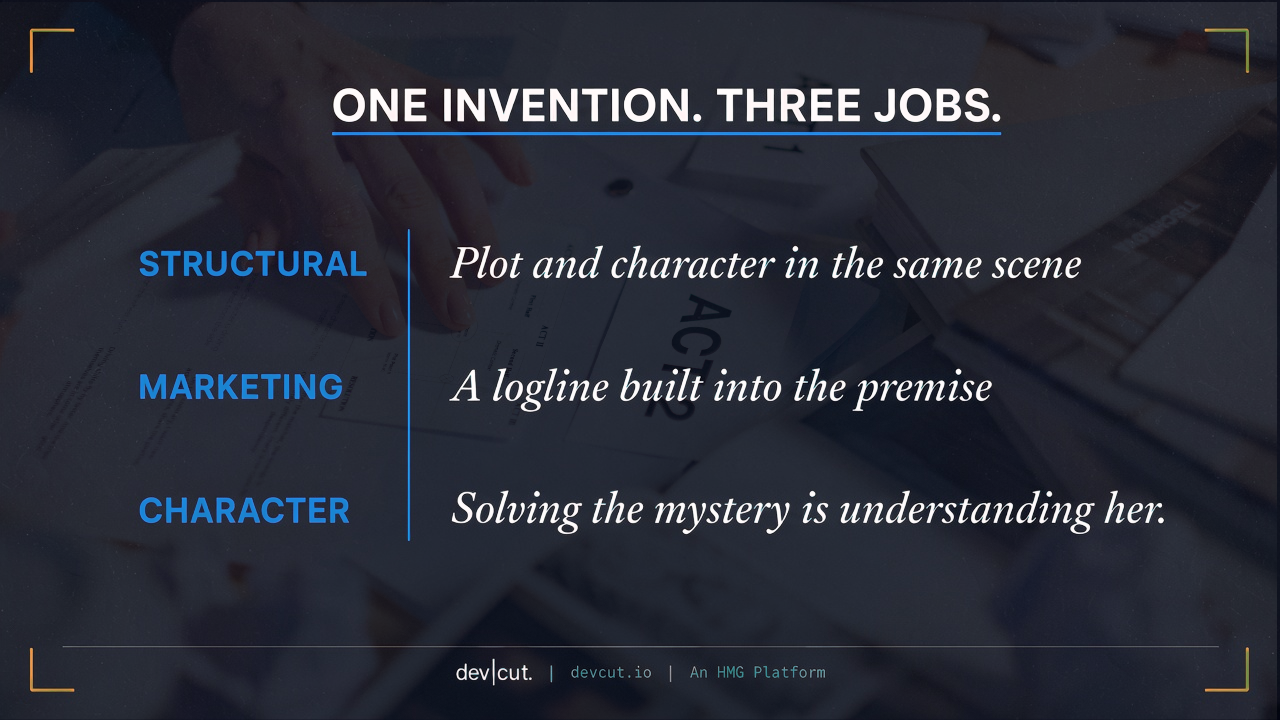
The invention: the protagonist's defining trait is also the literal mechanism of the mystery. She doesn't investigate the anomaly from the outside, she is the conduit for it. Every scene she's in is a scene the mystery moves in. Every clue is also a character beat.
That's one invention solving three problems most pilots solve one at a time (if they solve them at all):
A structural problem — keeping plot and character in the same scene, instead of plot happening in one lane and character developing in another next to it. Here, they're fused. Perception and investigation are one motion.
A character problem — is the person driving the mystery someone an audience wants to keep watching, regardless of how the mystery resolves? Here, you can't separate the two questions. Solving it and understanding her are the same endeavor.
A marketing problem — can this be described in a single sentence built around what's actually different about this person? Not a logline stitched on after the outline was locked. This one can.
If You're the Writer
This isn't really a checklist. It's a diagnostic.
Ask yourself whether your pilot's central invention is doing more than one job. If it isn't, you're probably writing three separate elements that each need their own scene time. And that right there is exactly why so many pilots feel overstuffed.
Even when every individual element works on its own, they all demand their own time to do so. The mystery is fine. The character is fine. The hook is fine. They're just taking turns instead of showing up together.
The fix isn't “add more plot” or “add more character.” It's asking whether the thing your protagonist is can also be the thing your story runs on. When it can, you stop managing three separate elements and start managing one that regenerates itself every episode.
Your pilot's protagonist has to be more than just a character.
If You're the Buyer or Producer Optioning It
This is the other half of the read, and it's the half most coverage skips.
If you're evaluating a pilot for a slate, a pitch room, or a series order, this same invention is the thing worth hunting for. And it's rarer than the query letters suggest. A conceit that only does one job runs out of momentum by the back half of a season. You've either exhausted the mystery, oversold a hook the show can't actually sustain episode to episode, or built a compelling character stuck circling a plot that's already spent.
A conceit doing three jobs at once has real runway, because you're not tracking three separate elements degrading at three different rates. You're tracking one, and it renews itself with every episode instead of running down.
That's not a taste call. It's a pressure-test worth doing before the pitch meeting.
Now, I'm not saying this is a must for every series, but when you see it, know it's a rare gem that is worth propping up as a significant find. Think of Prairie Johnson, Walter White, Dexter, Elliot Alderson, John Luther — all characters whose unique traits and circumstances drive every moment of the series, on or off screen. They are the engine. The driver. Never a passenger.

The pilot's central idea has to last for more than just the pilot.
Why Coverage Should Be Looking for This
Most coverage tells you whether a script is well-written. Few readers ask whether the central invention is durable. Is it built to run multiple seasons, not just to open strong?
That's a big part of why dev|cut. is truly different, and this is not just a launch-week line. Coverage that reads for the ‘three-job test’ isn't more work on the page, it's essential to understanding the series. It's a sharper question, one we ask on every report, for the writer polishing a pilot and the exec deciding whether to option it. The same read, doing both jobs, because a script that's ready needs to answer to both.
Wondering whether your pilot’s conceit can carry five seasons? Pilot coverage pricing.
[Soon] The story continues… — Brian Hanford, Writer & Founder, dev|cut.™ · devcut.io
← Back to Blog