How to Give Your Lead Agency
Why does a well-built script still feel passive? We break down protagonist agency, and a quick test to check if your lead’s choices are really theirs.
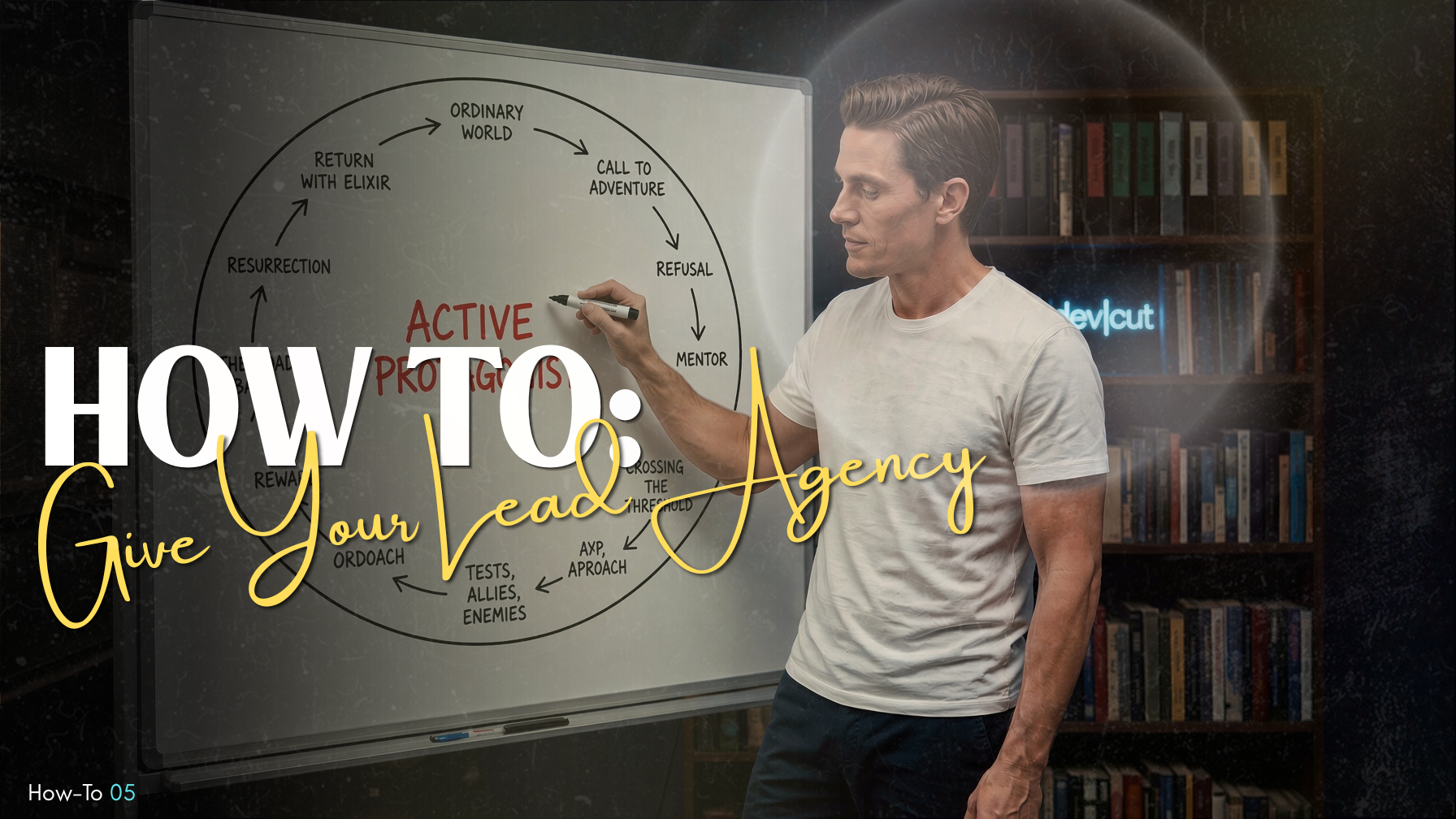
There’s a note readers give that has a penchant for showing up specifically on early-draft scripts. You may miss it because it doesn’t always look the same. Sometimes it’s “she feels a little passive here.” Sometimes it’s “we lose track of what he wants.” Sometimes it’s just “the protagonist doesn’t have much to do here.”
Nine times out of ten, what’s actually happening is simpler than any of those phrasings suggest: the story is happening to your protagonist instead of because of them.
Reacting isn’t the same as choosing
I know this feels a little like screenwriting 101, but it’s a crucial call out. Every lead reacts, sure, and that’s not the problem. Reacting is half of what makes a character feel human. The problem shows up when reacting is all they do, page after page, scene after scene. Something happens, they respond, something else happens, they respond again. It reads like competent writing, even like good character work, because the reactions can be sharp, specific, and emotionally true. But readers (and audiences) aren’t really tracking whether a character reacts well, they’re tracking whether that character is driving anything.
Agency is the difference. It’s not about your lead being aggressive, or particularly proactive, or even likeable in a scene-by-scene sense. It’s about whether the story’s direction can be traced back to a decision they made, not just an event that happened in close proximity.
Where agency actually shows up
This is where a lot of writers trip up. Agency doesn’t have to be loud to be real. It’s not always the character kicking down the door. In fact, a lot of the time, it’s smaller and easier to miss, both for the writer and for the reader. Yet, everyone still feels it.
A character has agency the moment they choose one thing over another and that choice costs them something. Keep the secret, or tell it. Take the meeting, or skip it. Stay, or leave. The size of the decision often matters less than whether it’s actually theirs, and whether the story lets us feel the weight of it landing.
This is also where reactive leads hide the best. A character can respond to five events in a row, and as long as one of those responses is a real choice with a real cost, the whole stretch reads as driven. Cut that one choice, and the same five beats suddenly feel like something happening to a person standing still.
The reactive-lead trap, and why it’s so easy to fall into
This script note tends to show up most in early drafts because reactive writing is genuinely easier. The plot needs to move, so you throw an event at your lead. Event lands, character responds, plot moves again. It’s a clean engine, and it can carry a whole first draft without anyone noticing anything’s wrong, because on a scene level, everything is working. Where it breaks down is at the level just above the scene, when we start to look at impact, themes, and messaging. If the character we’re meant to root for or follow for 90 minutes, or through seasons of TV, doesn’t act as the catalyst for anything, what’s the point of watching their story?
One of the immediate instincts writers and producers alike have when trying to fix this is to make a character smarter, snappier, more aggressive, and it usually backfires. Personality traits aren’t agency. A character can be quiet and still be the one steering the story, or they can be the loudest in the room, all that matters is it’s their choices which the plot hinges on.
Putting a protagonist to the test
Pull three or four of a protagonist’s biggest scenes from a script and for each one, ask: what did they decide here, and what would it have cost them to decide differently? If you can answer that cleanly, the scene is doing its job. If the honest answer is “nothing, they just found out what happens next,” that beat might need a second pass. But let me be clear, that doesn’t mean it’s badly written, it’s just a place your lead went quiet on you.
At dev|cut.™, this is a finding we’re always looking for when doing coverage. Why? Because your lead is the most important part of your script! And a script that’s structurally sound, well-paced, and emotionally alive deserves more than a lead whose decisions are thin on the ground. It’s rarely a full rewrite, just a focused look at specific beats where a reaction needs to become a choice.
If you want more of this, the craft breakdowns, the case studies, the occasional deep dive into what separates a strong draft from a stalled one, check out The Reader’s Note, our newsletter.
[Soon] The story continues… — Brian Hanford, Writer & Founder, dev|cut.™ · devcut.io
← Back to Blog