Verticals: The Format Where Problems Can’t Hide
How vertical series compress plot, character, and pacing into a minute or two an episode — and why it’s crucial to know what breaks first.
Vertical series are still the new kid on the entertainment block, and a lot of writers either dismiss them as a gimmick or treat them as a completely separate skill from “real” screenwriting.
Neither is quite right, in our opinion.
What verticals actually are is a pressure test. Compress a story down to a minute or two an episode and the format stops letting you get away with things a feature or an hour-long will happily let slide for pages at a time.
Knowing the difference is worth the time, because it can genuinely help you write better no matter what format you’re in. So let’s get into it.
Compression Doesn’t Create New Problems
It removes the padding that was hiding old ones.
Here’s the thing nobody seems to really want to admit: verticals don’t have some exotic new set of craft rules. They have the same rules everything else has, just with nowhere to bury the evidence of breaking them.
Take character setup. In a feature, a character who doesn’t really earn their page count can coast for a while. The audience gives them the benefit of the doubt for a scene or two, sometimes longer, before the “wait, why do I care about this person” feeling sets in. In a vertical, that grace period doesn’t exist. If a character doesn’t do something specific in the seconds they’re on screen, the audience knows it immediately. There’s no runway and nowhere to hide, so a problem that may well be sitting in a feature script too rears its head fast.
Pacing works the same way. Writers, and especially readers, tend to talk about pacing like it’s a feeling — “this section drags” — but it’s actually a structural fact once you get specific: this scene is doing a job and taking three times as long as it needs to do it. A feature can smuggle a slow scene past a reader because there’s a strong scene on either side of it. A vertical can’t. One flat beat in a ninety-second episode isn’t a slow patch. It’s an entire episode of this isn’t working.
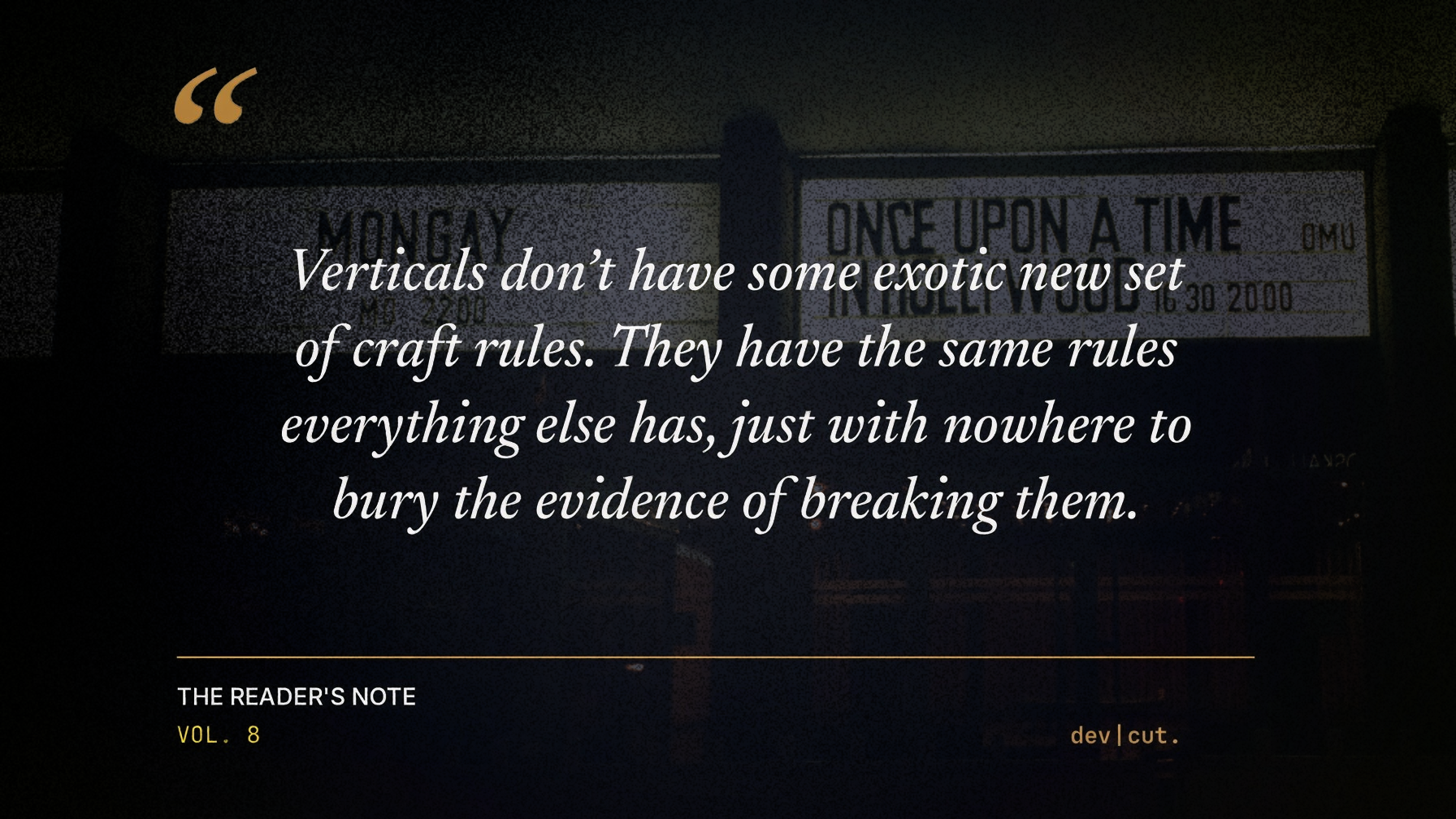
Verticals have the same problems as any script, with nowhere to hide them.
The Ending Problem (Briefly)
We wrote a little while back about cliffhangers that work versus ones that are just a cheap jump-scare with a quick cut-to-black — worth a read if you missed it.
Verticals have their own version of that failure, and it’s worth mentioning. So what is it? An ending that doesn’t close and doesn’t open. It just… stops. No bet placed, no question left hanging, just a cut. It reads like an ending because something happened and then credits rolled, but nothing was actually promised.
What This Reveals About Screenwriting
…and it has nothing to do with verticals.
This is where we get to the meat of it, and it’s the reason this format deserves more respect from people who’ve never written a vertical episode: none of what verticals expose is unique to verticals.
A reactive character, a scene that isn’t earning its runtime, an ending that doesn’t commit to anything — those are craft problems in any script. They’re just easier to miss when you’ve got ninety more pages for the audience to forget about them.
None of what verticals expose in screenwriting craft is unique to verticals. The Reader's Note, Vol. 8
If you’re writing a vertical: the test is blunt and immediate. Does this beat do a job in the seconds it has, or is it there because the story needed something to happen? There’s no room to answer with “eventually.”
If you’re writing anything longer: the same test still applies, it’s just easier to talk yourself out of actually doing it. Try this: pick any scene in your script and ask what job it’s doing in isolation. Not what it’s doing relative to the scenes around it. If a scene only works because of what comes before and after it, that’s worth a second look, because you might want to rethink it or just plain cut it. Even in features, pages count.
If You’re Producing or Optioning a Vertical
This is the half of the read worth paying closer attention to right now, because verticals are moving fast and a lot of the material coming through is being evaluated with feature-length instincts by people who haven’t fully recalibrated yet.
The tell in coverage is almost always the same. You get a vertical script that reads fine scene by scene but never gives a clear “why should I watch episode two” answer. And why? Because every episode is doing the job of continue the story instead of the job of place a bet worth following.
That’s a pacing note dressed up as a format note. It shows up in verticals because there’s nowhere to hide it, but the underlying problem — plot happening instead of stakes accumulating — is the same one that sinks slower-burn TV shows too. It’s just a lot more expensive to discover three episodes into a season order than it is on the page.
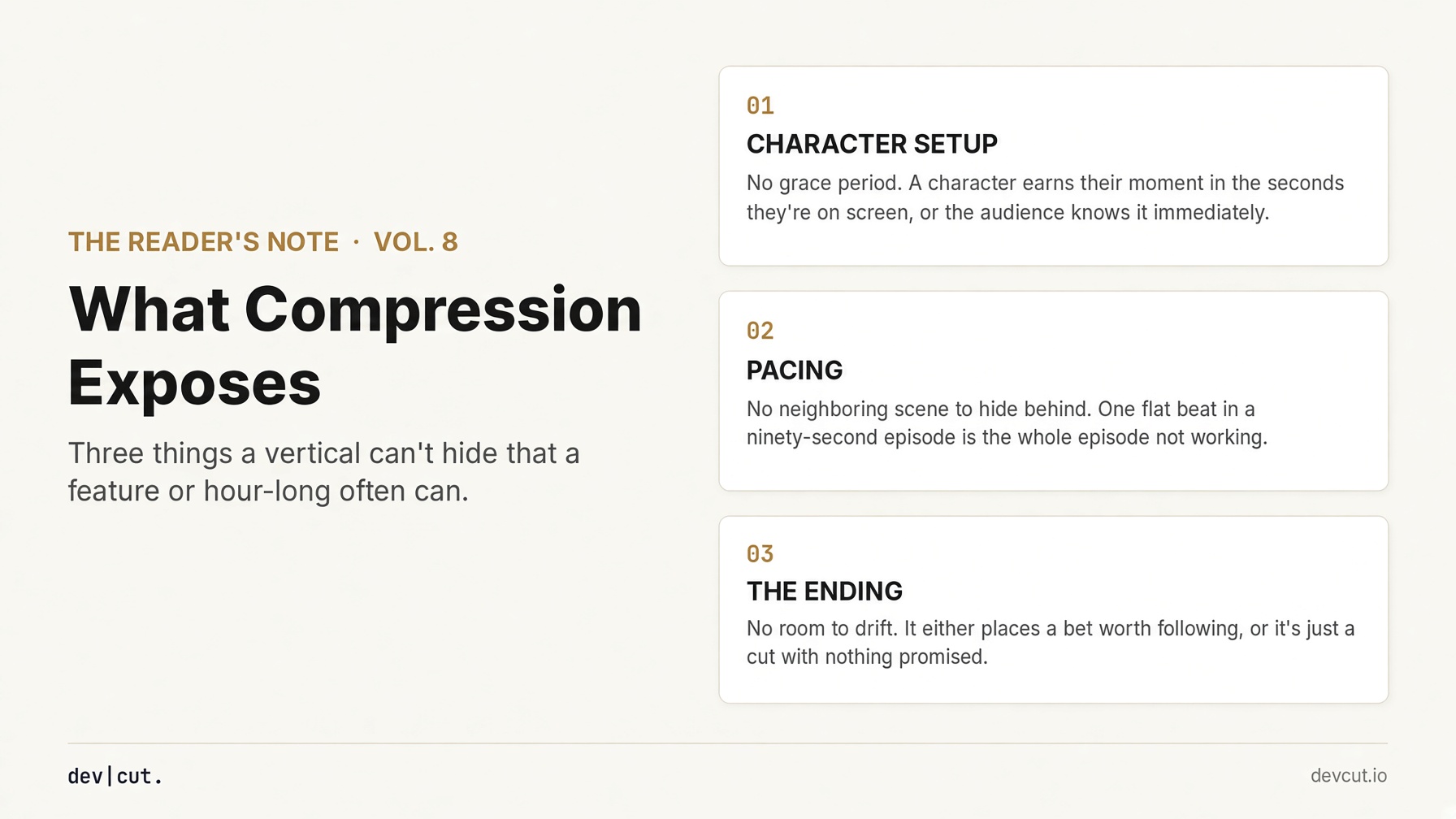
The three biggest problems exposed in vertical scripts.
Why Coverage Should Be Looking for This
Most notes on a vertical script stop at “is it fast enough” or “does the hook land in the first few seconds.” Those matter, but they’re surface questions. The better question is whether every beat is doing real work, because a format with no room to hide is also a format that tells you, fast, whether the fundamentals are actually there.
That’s the read we try to give any script that comes through dev|cut.™, vertical or not. Not just “did this move,” but “is every piece of it earning its place.”
If you want more of this — the craft breakdowns, the buyer-side thinking, the occasional pilot that does three jobs at once — you know where to find us. Wink.
Writing in the format? How we cover verticals.
Wondering whether every beat in your script is earning its runtime? See coverage pricing — founding rates hold through September 30.
[Soon] The story continues… — Brian Hanford, Writer & Founder, dev|cut.™ · devcut.io
← Back to Blog