The Cold Open Is a Promise, Not a Trailer
Why the best pilots don’t open with a hook — they open with a bet the rest of the season has to keep.
Every pilot has a first image. Most writers spend real time on it — and with damn good reason… it’s the first thing anyone sees. Yet a lot of that time goes toward the wrong goal. Well, not “wrong,” but the lesser of two goals. The question usually being asked is “how do I hook them in the first three pages?” The more important question is “what am I promising, and can the next 10 episodes actually keep it?”
That distinction is the whole ball game in TV, and I want to dive into it.
The Hook vs. the Thesis
Most cold opens are built as hooks: a flash-forward, a body, a chase, something loud enough to buy the audience’s attention before the title card. Nothing wrong with that on its own… a hook has a big job. It’s just not the same job as a great cold open, and a lot of pilots stop at “loud” without asking what comes next.
Think about Breaking Bad’s pilot. Cold open: a man in his underwear, driving an RV through the desert, gun in hand, recording a goodbye message to his family. That’s a hook, sure. You, me, and quite a few million other people couldn’t wait to keep watching.
But look at what it’s actually promising underneath the shock value: an ordinary man, forced by circumstance into something completely outside his life, moving fast enough that he can’t see where it ends. Every scene, episode, and season after that image is, in some sense, still answering the question that image asked. That’s not a hook. That’s a thesis statement the whole series is built to prove.
Compare that to a pilot that opens with an exciting action beat that never really connects back to anything. It got you to keep watching episode one. It didn’t tell you what the show actually is. Those are two very different jobs, and only one of them is durable.
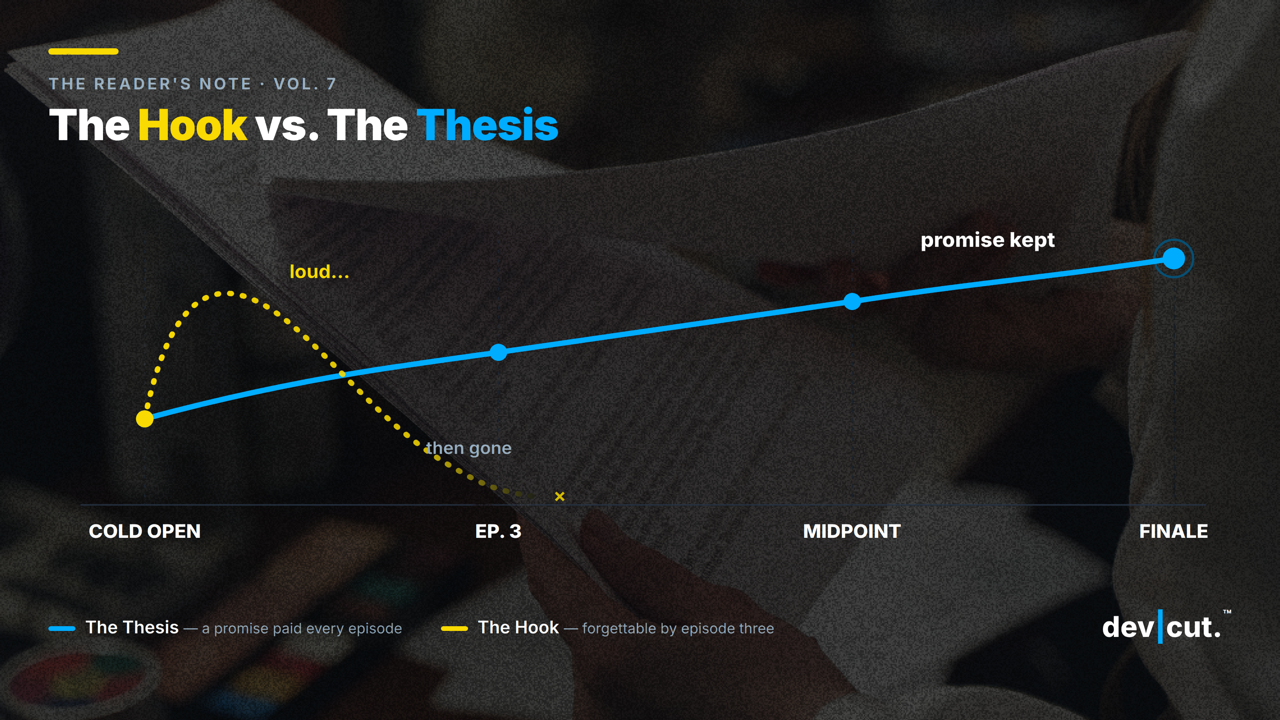
A series not only needs a great cold open, but to deliver on it throughout.
If You’re Writing It…
Here’s the test: point to your finale (or your season’s midpoint, if that’s as far as you’ve mapped) and trace a line back to your cold open. Is there a direct thread, or did the story wander off and leave that opening image behind by episode three?
If there’s no line back, you probably have a hook, not a thesis, and that’s fixable. Not by changing the whole open, but by clarifying what it’s actually promising. Ask what your cold open is telling the audience they’re signing up for. Then ask if the rest of the season is actually built to deliver on that, episode after episode, not just the pilot.
This isn’t about making the opening quieter or slower. Going back to the Breaking Bad example, the cold open is genuinely loud. The loudness isn’t the problem, and it’s not the point either. What matters is whether the noise is attached to something the show keeps paying off.
If You’re Buying / Optioning It…
This is the half of the read that gets skipped more often than it should. A cold open that’s exciting on the page can absolutely get a pitch meeting. It’s a much shakier bet for a series order, because the room rarely stress-tests whether that opening promise survives past the pilot.
The question worth asking in the room: if this show runs three seasons, does the cold open still make sense as the thing that started it? Or does it read, in hindsight, like a great three pages bolted onto a show that turned out to be about something else? The second kind gets a strong pilot and a shaky season two, because the writers’ room ends up chasing an opening that was never really load-bearing to begin with.
A pilot where the cold open is genuinely the thesis has real runway for the same reason a durable central conceit does — the invention doing more than one job, the character built to carry the weight — because you’re not managing a flashy opening that has to be topped or abandoned. You’re managing a promise that pays interest every episode it keeps.
Why Coverage Should Be Looking for This
Most notes on a cold open stop at “does it hook you.” Fewer readers ask whether it’s a promise the rest of the season is actually built to keep — which is a much better predictor of whether a pilot has real legs.
That’s the read we try to give every pilot that comes through dev|cut.™ — we want to do both because both matter, big time. Coverage should answer “did the opening grab me?” but also “is the opening the show, or just the best three pages the writer had?” That’s the kind of coverage that moves a script forward.
If you want more of this — the craft breakdowns, the buyer-side thinking, the occasional pilot that does three jobs at once — you know where to find us. Lots more to come.
Wondering whether your cold open is a promise your season can keep? Pilot coverage pricing.
[Soon] The story continues… — Brian Hanford, Writer & Founder, dev|cut.™ · devcut.io
← Back to Blog