How to Write a Cliffhanger (That Isn't Just a Cheap Trick)
A lot of cliffhangers are like a jump-scare, cheap thrills that get forgotten. Here's how to craft one that works, and the test to make sure.
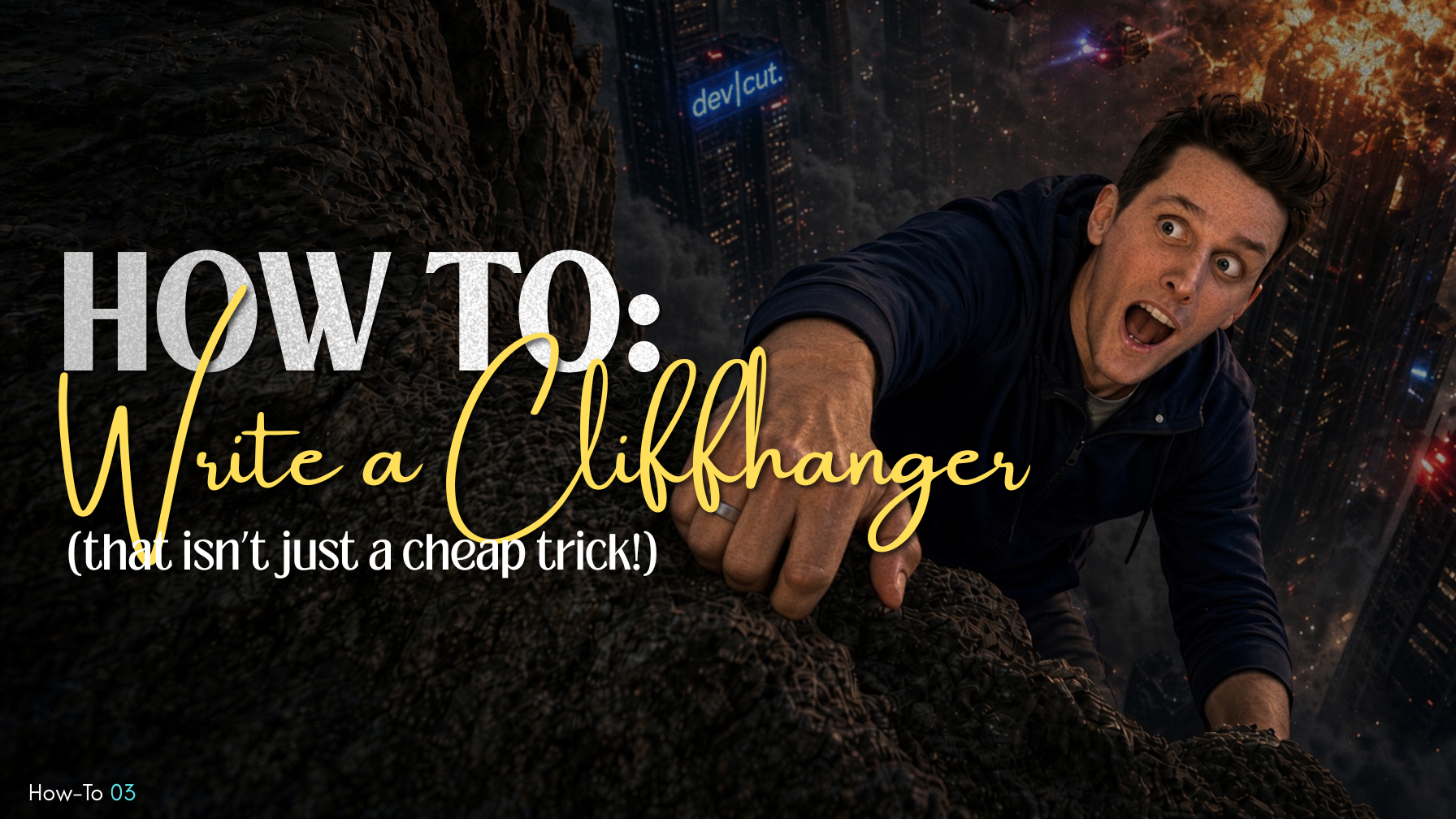
Most people can identify with that feeling of watching an episode cut to black at exactly the ‘wrong’ moment and being pretty much forced into immediately reaching for the remote to start the next episode. But few pay attention to why that particular cut worked. A lot of what gets written under the label “cliffhanger” doesn't do what that one just did, so what made it so effective?
First, we have to start with what a cliffhanger is actually for, because contrary to what some may think, it's not about “leave them wanting more.” That's the desired effect, but it's not the mechanism.
A cliffhanger is a bet, not a jump-scare
Think about it like this: a cliffhanger is a bet you're making with the audience about what they want to know next. The gasp, the cut to black, the unseen antagonist… those are just how the bet gets placed. If there's no real motivation underneath the moment, you don't have a cliffhanger, you have what's essentially a jump-scare with better lighting.
The test is simple, but honestly, it can be a little uncomfortable for writers to run. You have to ask yourself, “can you say, in one sentence, what the audience wants answered before they'll watch the next episode?” If you can't, the moment you just wrote is a mood, an unexpected gasp. Again, cheap thrills but not a cliffhanger. Moods are beats that fade by the next commercial break whereas a real cliffhanger doesn't. It holds you like a vice!
The fake cliffhanger, and how to spot it in your own draft
False flag operations in a script are killer because they're easy to write and even easier to fall in love with. Why? Because it feels tense on the page even when it isn't earning anything. The kind of page you get done writing and give an “oooooo” to yourself. We've all done it.
Usually it looks something like danger without a real question attached. Maybe a gun goes off, or a car swerves, or my personal favorite… the scream and smash cut to black. It reads exciting, and hey, at that moment it is. Yet, it's not going to make anyone show up next week because there's no actual uncertainty about what happens next. Come on! We all know the lead survives, the show is literally named after them, or they're making too much per episode and contracted to three more seasons. We just don't know how yet, and “how” is rarely enough to carry an audience across a week (or, these days, across the three seconds it takes to click ‘Next Episode’).
Compare that to a moment where the danger comes attached to a real question the audience has been tracking for the whole episode or more. That's the difference between “something scary just happened” and “something I've been worried about just got worse.”
Three kinds of cliffhangers (and most scripts only use one)
Plot danger. A character's physical safety or immediate goal is suddenly at risk. The most common kind, and the one most writers reach for by default. Works fine on its own, but it's the weakest of the three when it's not paired with something else, because physical danger alone rarely survives a full week of real-life distraction.
Revelation. The audience, or a character, learns something that reframes everything that came before. Think of the moment Darth Vader tells Luke the truth about his father. Nobody was worried Luke would fall off the platform. Everyone was too busy reeling because the entire story just changed shape. Revelation cliffhangers are durable because they don't rely on suspense based on survival, they rely on suspense about meaning, and meaning doesn't resolve itself easily.
Relational. A relationship shifts in a way that can't be un-shifted. A great example is the Season 2 finale of Succession, when Kendall turns on his father at the press conference that was meant to save him. Instantly, audiences wanted… needed to know what comes next because his relationship with Logan had just changed forever. Relational cliffhangers are durable because they don't rely on suspense about danger, they rely on suspense about connection, and connection doesn't easily reset once it's broken.
Most cliffhangers only reach for the first one but the strongest episodic scripts I've read tend to stack at least two.
The test to run before you lock the cut
Next time you're closing out an episodic script, sit with it and ask yourself, “does this moment change what the audience wants, or just what they're worried about?” Worry fades. Want doesn't. “I hope she's okay” might get you through the credits. “Holy sh*t! Now I need to know if he knew all along” gets you to next week.
If your ending only produces worry or a quick jump, look for a version that also produces want. Attach the danger to revelatory information, a relationship, or a choice… not just standing alone.
The mistake that undoes a good cliffhanger
This one shows up far too consistently in episodic coverage, particularly in thrillers. The cliffhanger lands, and then the very next scene resolves it in the first thirty seconds with no cost. The gun that was pointed turns out to be unloaded. The confession turns out to be a dream or a misunderstanding cleared up over coffee. I like to call it ‘cliffhanger amnesia’, because that's what it trains the audience to do: stop trusting that endings mean anything.
Now, of course, you don't have to follow through on the worst-case version of every cliffhanger. But however you resolve each one needs to cost something the audience can feel, or the next one you write starts from zero credibility.
One last thing
A cliffhanger isn't a tool for covering a weak middle of an episode. If anything, it's the opposite, it only works when the audience already cares enough about the answer that withholding it for a commercial break, a week, a year between seasons… actually hurts a little. Write the meaning underneath it first, then the cut to black is the easy part.
For us, this is exactly the kind of structural bet we look for when we're doing coverage on a pilot or a mid-season episode. Sure, the ending is exciting, but is it a bet the story can actually cash in later? Make it both!
If you want more of this, the craft breakdowns, the buyer-side thinking, the occasional pilot that does three jobs at once, check out The Reader's Note (our newsletter).
Want more of this? Subscribe to The Reader's Note.
[Soon] The story continues… — Brian Hanford, Writer & Founder, dev|cut.™ · devcut.io
← Back to Blog