Yes-man technology, and the case against it.
A reader's note on the critique of AI coverage that's actually right — and why it matters to your script.
There's a version of the “AI coverage is garbage” argument that I don't push back on. In fact, I almost entirely agree with it.
The complaint goes something like this: most AI script coverage is just yes-man technology. It has no taste. It can't challenge a writer's actual choices. Sure, it'll flag a typo, maybe a pacing wobble [if you're lucky], and then it tells you the writing is good, because a tool that upsets you is a tool you stop using. It's fine for a spell-check. Useless for anything that requires an actual opinion.
I've heard some version of this argument a bunch this year, from people whose judgment I take seriously and from industry pros I've asked personally. I'm sure you've seen it as well. Here's the truth: they're right. Most of what's being marketed as “AI coverage” right now is exactly that. And it lands harder this year than it would have two years ago, because the platform closures that made this conversation urgent took away most of the places a writer could go for a second opinion.
So let's not pretend otherwise. Instead, let's go through it head on!
The Complaints, Taken Seriously
“It sugarcoats. It won't challenge you.”
This is true of almost any tool built to keep you engaged. The why is simple: because a tool that tells you your third act doesn't work is a tool you might stop opening tomorrow. That's not a personality flaw. It's an incentive problem, and it's baked into how most of these products get built.
The fix isn't a setting you toggle to “brutal.” It's structural. Severity has to be locked to an objective definition before a script ever gets read. It's easy to assume AI is naturally objective, but… cue the ‘dun dun dunnnnn’ — it isn't. Not when it comes to creative evaluation anyway. AI is smart enough [duh] to know humans are emotional, and that a harsh note risks losing you for good. So, more often than not, AI doesn't get harsh.
Objectivity in a coverage tool isn't a default setting — it has to be built in on purpose. Not calibrated to what keeps a subscription active. Not softened because the tier you paid for should feel encouraging. Strong critique has to mean the same thing in every coverage report, for every writer, whether or not it's a comfortable note to give.
“It has no taste. It just regurgitates.”
This is the harder one, because it's really a question about grounding. An AI model that's read a lot of screenplays or craft books (Save the Cat, Adventures in the Screen Trade, etc.) but has no sense of what actually got made, and why, isn't offering taste. It's offering pattern-matching.
Real “taste” in coverage comes from grounding — not just knowing the theory, but what's actually gotten made, and why it worked or didn't. Coverage with real taste can tell you when your thriller's midpoint is too vanilla compared to what's actually selling right now, or your romantic drama doesn't pull off a love triangle through today's lens. And that's not just a vibe — there's a factual floor under a note like that, whoever (or whatever) is writing it.
Every note in the coverage of a script has to have stakes.
“You need a human who actually believes in you.”
Also true, and also the one no engine — ours included — gets to skip. A human offers what a machine can't: understanding. Knowing that you're intentionally breaking the ‘Act 2 reversal’ mold, or that your hero is meant to feel like an antagonist until the coda. A human gets certain things because they've been in your shoes. AI has never tied laces on screenwriting's proverbial Chuck Taylors… plain and simple.
For us at dev|cut. we take that part seriously and it's in our entire company's DNA. Every report comes with a named human reader's actual notes and sign-off. Not a courtesy. Not an upsell. The read isn't finished until a person puts their name on it.
The Anton Ego Mechanism
There's a scene near the end of Ratatouille (which rocks by the way, one of my favorite films) that epitomizes what we're talking about. Food critic Anton Ego — the one everyone's been dreading all movie, the one whose whole professional value is that he will never simply tell you “it's good” — he sits down, takes one bite, and is transported. The whole reason that moment lands is because he's the harshest guy in the room. His praise actually costs something. So, when he goes in for a second bite, you know that food is worthy of it.
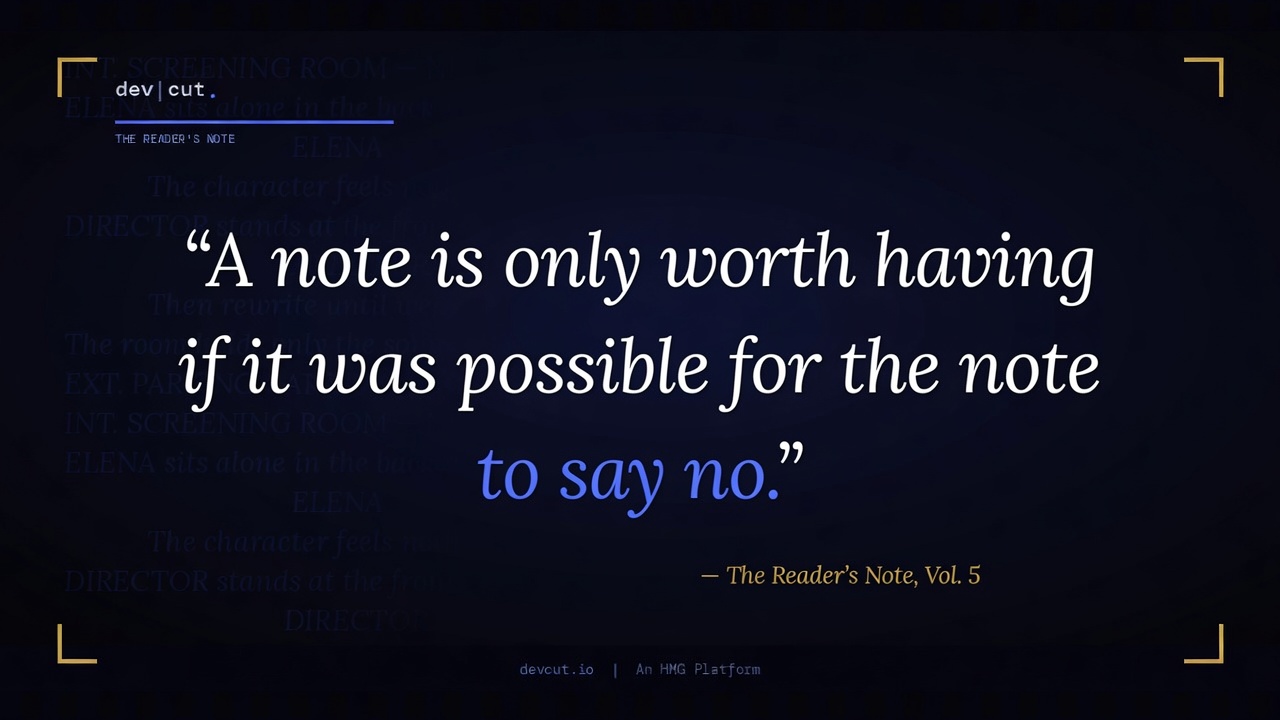
That's the whole argument, really. A note is only worth having if it was possible for the note to say “no.” Software that's engineered to keep you subscribed can't tell you “no” in any way that matters. That's not a technology problem. It's an incentive problem disguised in a scantily clad yet surprisingly tasteful technology costume.
Can We Give AI Its Due?
None of this means AI has no place in a coverage process. That's a different, lazier argument, and it's certainly not the one I'm making.
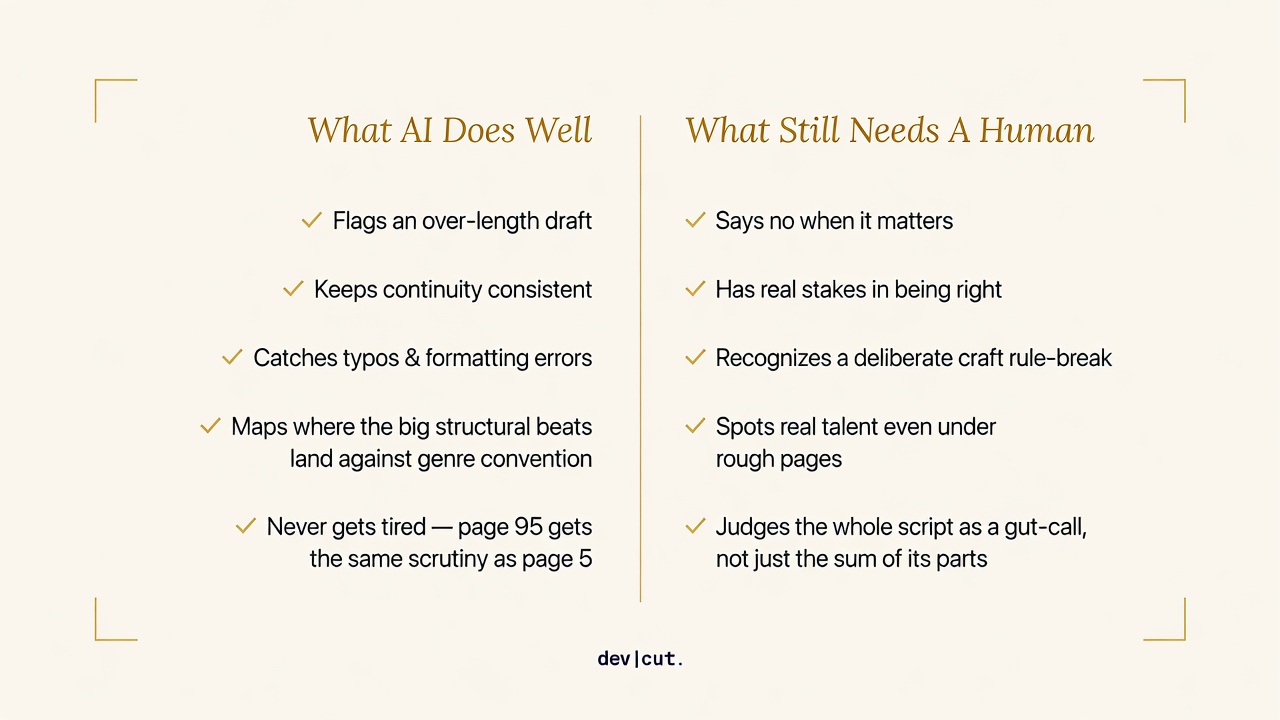
A model that can read thousands of scripts is genuinely useful for the mechanical layer: catching a POV slip, flagging a script that's forty pages over the format's norm, noticing a character's name changes spelling on page 60. It doesn't get tired on page 90 the way a human reader might. It doesn't skim. Used for that layer specifically, it makes a read more consistent, not less honest.
The trouble starts the moment a tool tries to do the other layer. The layer where somebody has to decide whether a script actually works, and say so even when the answer is complicated, or unpopular, or costs a subscriber. That layer has never been mechanical. It's a judgment call, made by someone with actual taste and (and don't forget this next part) actual stakes in being right.
So what's the best case? In our opinion, a hybrid. AI, for the parts that benefit from consistency and scale. A human, for the part that requires an opinion. Coverage that's honest about which is which is doing something real. Coverage that says the first thing is also the second thing is where “yes-man technology” comes from in the first place.
A human is key. Not because the technology isn't capable, but because taste was never a technology problem anyway.
The Thing We're Trying to Do
This is why we're building dev|cut.
Not to win an argument with the skeptics. Honestly, most of them are right about the thing they're describing. But this… isn't that. We built dev|cut. to be the alternative — coverage that matters and moves a script forward. Not something that flatters you into staying. That isn't coverage. It's a mirror with a subscription fee.
Founding pricing opens in a couple of weeks. More on that when it's actually here. For now, just the read.
If you want coverage that will actually disagree with you, that is the whole point of what we built. Coverage pricing.
[Soon] The story continues… — Brian Hanford, Writer & Founder, dev|cut.™ · devcut.io
← Back to Blog