A Scene Has More Than One Job
A reader’s note on why scenes need to do more than drive plot: they need to create moments a script can’t live without.

The quickest way to tell if a scene is working is to ask what it’s for. If the answer is a single sentence about plot — something like “this is where she finds out about the money” — you’re probably looking at a scene that’s doing its baseline job and stopping there.
On the surface, that sounds fine. After all, it’s what scenes are supposed to do. But after enough scripts, I’ve come to think scenes that do only one thing are what can make a script feel thin even when the structure is sound. The scene delivers the information, the story moves, and the page turns… and then it vanishes. Why? Because it never gives you a reason to remember it. A scene that’s only there because the plot logic says it has to be isn’t the same as a scene the script couldn’t be the same without.
The Plot Job Is the Entry Fee
Every scene has to move something forward. That’s the plot job, and it’s non-negotiable. A scene with no plot job is a scene in search of a reason to exist.
But the plot job is the minimum, not the goal. The scenes readers remember are the ones carrying two or three other loads at the same time. A character reveals who they are. A relationship shifts by a degree. The tone tilts. A setup gets planted that won’t pay off for forty pages. A theme shows its face without saying its name.
Think about the wedding at the top of The Godfather. On paper, the plot job is simple: a man asks for a favor and a debt is established. But is that all the scene carries? Hell no. We meet the whole family. We learn who defers to whom and who doesn’t. We see how power works in this world: quietly, politely, through obligation. The tone is celebratory and menacing at the same time. One location, one afternoon, and the scene has been working five jobs at once without ever slowing down to announce any of them.
The Detour That Is Anything But
The flip side is a scene that looks like a detour. In Fargo, there’s a lunch scene that seems to have nothing to do with the case. It’s a meeting with an old acquaintance, there’s some small talk, a little sadness, and the plot job is almost nothing. Yet the scene earns its place because of what else it’s doing. It tells us about the person across the table, it tells us how the lead treats people, and it quietly sets up something that matters later. Take away the plot job and the scene still works. That’s the sign you’ve built it right.
That’s the standard I’d offer and encourage any writer to think about. If you remove the plot job, does anything still hold the scene up?
Answering the Call
You can run this test on your own pages. Pick a scene from your latest draft of any script. Then write one short sentence for each job it does. Plot is one, but don’t stop there. Look for the others. What does this scene tell us about a character that we didn’t know a page ago? What shifts between these two people? What mood does it establish or break? What is it planting for later, or paying off from earlier?
If you can only write one sentence, the scene is doing one job. By no means does that suggest you should cut it, but it does raise two questions. Could this plot job live inside another scene that’s doing a different job? Could this scene take on another job and do more?
So how do we find the second job?
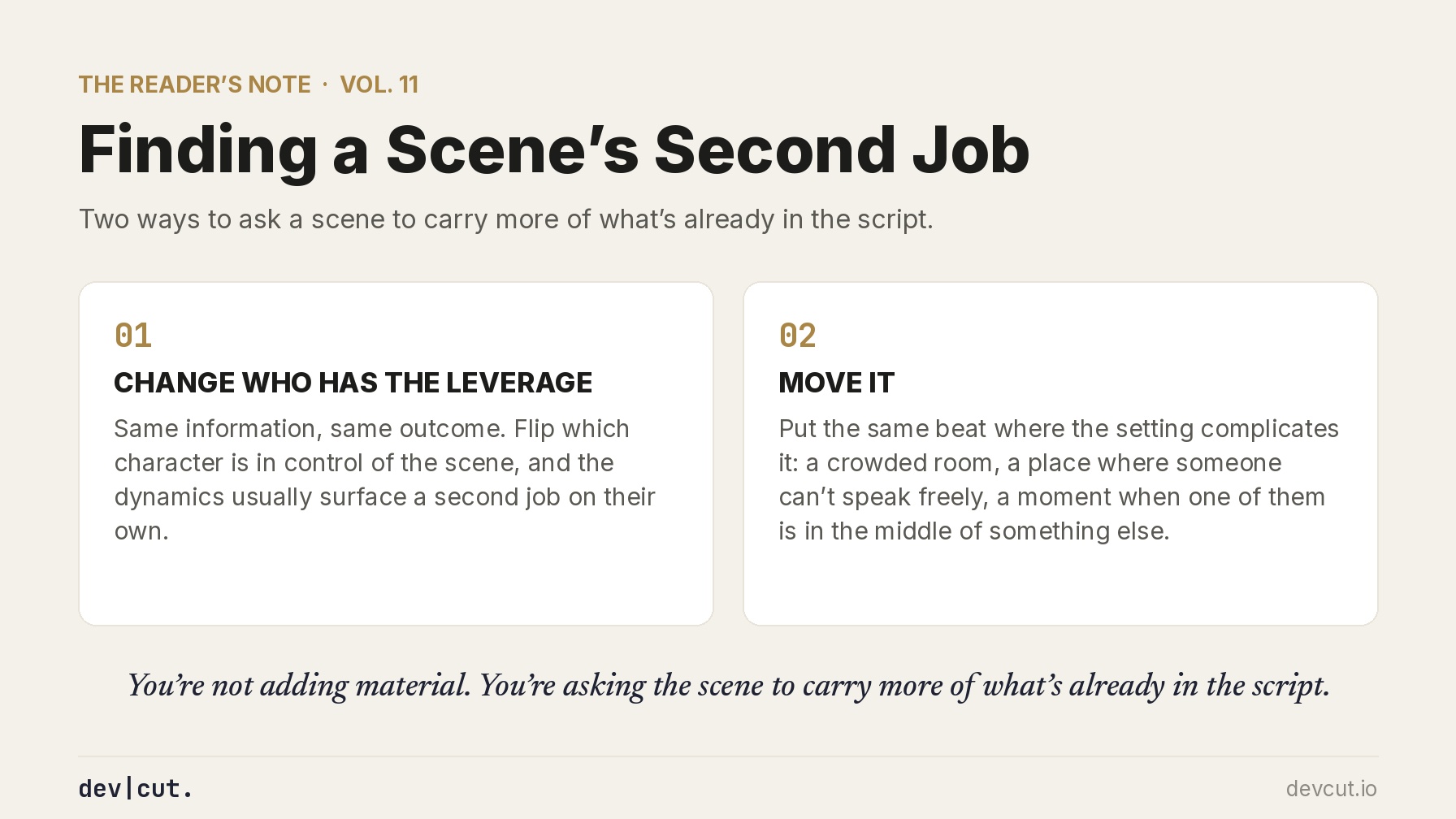
Either way, you’re not adding material. You’re asking the scene to carry more of what’s already in the script. That’s the same muscle behind writing subtext: the page says one thing while the scene carries another.
If You’re a Reader or Producer
This is one of the patterns that drives a coverage verdict. A script full of single-job scenes rarely earns an angry note. Potentially worse, it earns a lukewarm one full of adjectives like “competent,” “clear,” “functional.” The read goes fast and leaves nothing behind. In a script pile, that’s a hard place to be, because a reader can finish a draft like that, agree with every choice, and still struggle to say what the script is about. Ninety-nine times out of a hundred, that means a pass.
The scripts that stay with a reader tend to have fewer scenes, but those scenes are working harder. If you’re looking at a draft and wondering why it’s longer than the story needs, check how many of the scenes are doing one thing. Compressing a single-job scene into a double-job one often saves a page and gives the draft depth in the same move.
The Thing to Take Away From This
You don’t have to overhaul your script. Pick the five scenes you’re least sure about and write down the jobs each one does. If a scene comes back with one, you’ve found the spot to work on first.
That’s the kind of read we try to give at dev|cut.™: not just whether a scene functions, but what else it could be carrying.
Want a read this specific on your own script? See pricing.
[Soon] The story continues… — Brian Hanford, Writer & Founder, dev|cut.™ · devcut.io
← Back to Blog