The “Nothing’s Wrong With It” Paradox
A reader’s note on the scripts that read fine, but are forgotten by morning.
It’s not enough for a script to be well crafted, it has to be something readers don’t forget!
There’s a particular kind of script I see every now and then that never makes me reach for a pen.
On the surface, it’s solid. The formatting’s right, the scenes turn, the dialogue does its job, and each act lands roughly where they should land. I finish reading and I have… nothing to flag. No urgent note, no structural crisis, nothing I’d call broken or not working.
Then I wake up the next morning and I find myself trying to remember what it was even about.
That’s the kind of script I want to talk about this week. Not bad scripts, competent ones, where most choices are defensible but few of them are memorable. And let’s be real… that’s a problem when competing with the rest of the scripts in a stack. “Nothing wrong” is not the same thing as “something right,” and readers, producers, and agents alike feel the difference.
“Competent” is a default setting
A script with no problems is usually made up of first choices.
So, what do I mean by that? The hero wants “justice,” or “to save the family,” or “to win.” The apartment is “a nice apartment.” The small town is “a small town.” A character who needs to say something important says it, clearly, in the scene where it’s needed. Each of those choices is reasonable. And that, my friends, is exactly the issue. The first idea you have is, almost by definition, the one most other writers had too.
This isn’t a skill problem, and I want to be clear about that. In no way am I saying a person can’t write. It’s more that clarity and specificity tend to pull in opposite directions at the wrong moment. When you’re worried about confusing the reader or that a beat might not land, you reach for what everyone already understands, and what everyone already understands is what they’ve already seen.
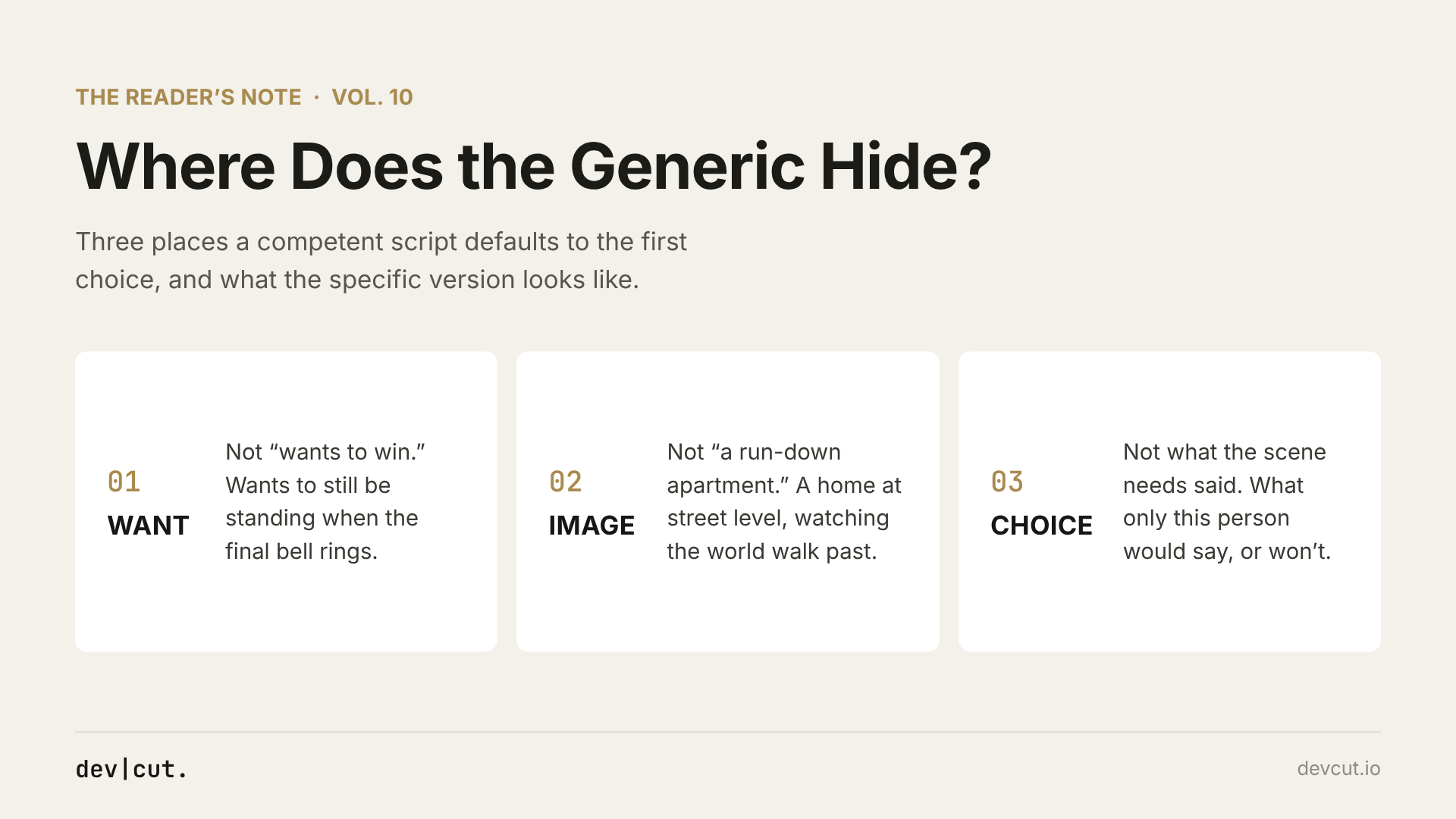
‘Generics’ tend to show up in three places.
The want. “He wants to win” is a want. It’s also a want that could belong to a thousand characters. Think about Rocky. His want isn’t to win the fight, it’s to still be standing when the final bell rings. That’s smaller, stranger, and a lot easier to feel in your own chest. The first version gives an actor an outcome. The second gives them a scene.
The image. “A run-down apartment” tells the reader what a location line could have told them. Now, think about the family in Parasite and the way their home sits at street level, looking up at the world walking past. You understand a whole class system without a word or action. One specific image can do the job of a page of dialogue, and it’s the thing people are still thinking about the next morning.
The choice. In the forgettable version, people say what the scene needs them to say. Functional yes, unique no. In the memorable version, they say the thing only they would say, or they don’t say it at all. Same plot, different person on the page.
Why does it happen?
A lot of it comes from how we revise a script. Most of us are trained to fix problems: the sagging middle, the muddy motivation, the scene that goes on too long. And that’s a good instinct. But a script edited against a checklist can start to flirt with the average. It’s almost like each note or fix sands off a rough edge, and more often than not, rough edges are where the personality was. You can revise a script until nothing’s wrong… and nothing’s there.
Sleep on it…
Sometimes stepping back is the best way forward. Try this little test on your own pages.
Finish a read of your script (or hand it to someone you trust and ask them to do the same). Then leave it alone until the next morning. No re-opening it, no peeking at the outline. Sleep on it! Then, when you wake up, write down the five things you remember.
Now sort them into these two groups:
- Plot events (“the sister finds the letter”)
- Specifics (a person, an object, a choice, a line, a picture)
If everything you remember is plot, the story survived revision but the script didn’t. And that’s your signal.
Take a scene from the plot pile and ask what the ‘first choice’ was in it: the want, the location, the thing a character says. Then ask yourself, what would the second or third or fourth choice be? The first idea is the average one. By the third, you’re usually somewhere that only this script could be.
You don’t need to do it everywhere. A handful of specifics, placed on purpose, is usually enough to change how the whole script is remembered.
If you’re producing or optioning
This is the read that’s hardest to act on. A script with real problems gives you something to say in the room. A competent one gives you a polite shrug, because there’s nothing to really spotlight, good or bad.
When a reader is working through a pile of capable scripts, the one with a person and a picture they can still see the next day tends to be the one that gets talked about, and talked about often. That’s not a prediction about any buyer or project, and plenty of good scripts get quiet passes. It’s just how memory works. If you’re developing something, it’s worth asking early what the script would leave behind with someone who read it on a Tuesday and was asked about it on a Wednesday.
Why this is what coverage should be looking for
A clean script is one of the hardest to cover well, because a checklist finds nothing. At dev|cut.™, the question we try to answer isn’t only “what’s broken,” it’s where a first choice is standing in for a decision, and where the script could be more clearly, specifically, unmistakably yours. Analysis and a suggested direction, not an order. What you do with it is up to you.
A script doesn’t need to be strange to be memorable. It needs to have been chosen with intention and specificity, one moment at a time.
Want a read this specific on your own script? See pricing.
[Soon] The story continues… — Brian Hanford, Writer & Founder, dev|cut.™ · devcut.io
← Back to Blog