Down Is Safety: Can Direction Alone Carry a Theme?
The dialogue doesn’t announce it. The blocking does.
Writers reach for theme in their scripts through the obvious channels most of the time. A line of dialogue, a recurring image, a structural echo between a story’s opening and its ending. All of those work. But those aren’t the only ways in.
A script that just came through dev|cut.™ this past weekend does it differently, and is all the better for it.
Canopy, written by Brandon Feldman, uses an unexpected device. The protagonist is trying to escape the dangers of an unfamiliar environment while on a mission to find the one thing that could save her family. It’s a visceral, tense survival story in the vein of The Descent. However, the thematic argument underneath it isn’t stated once, anywhere. It’s built entirely into… direction.
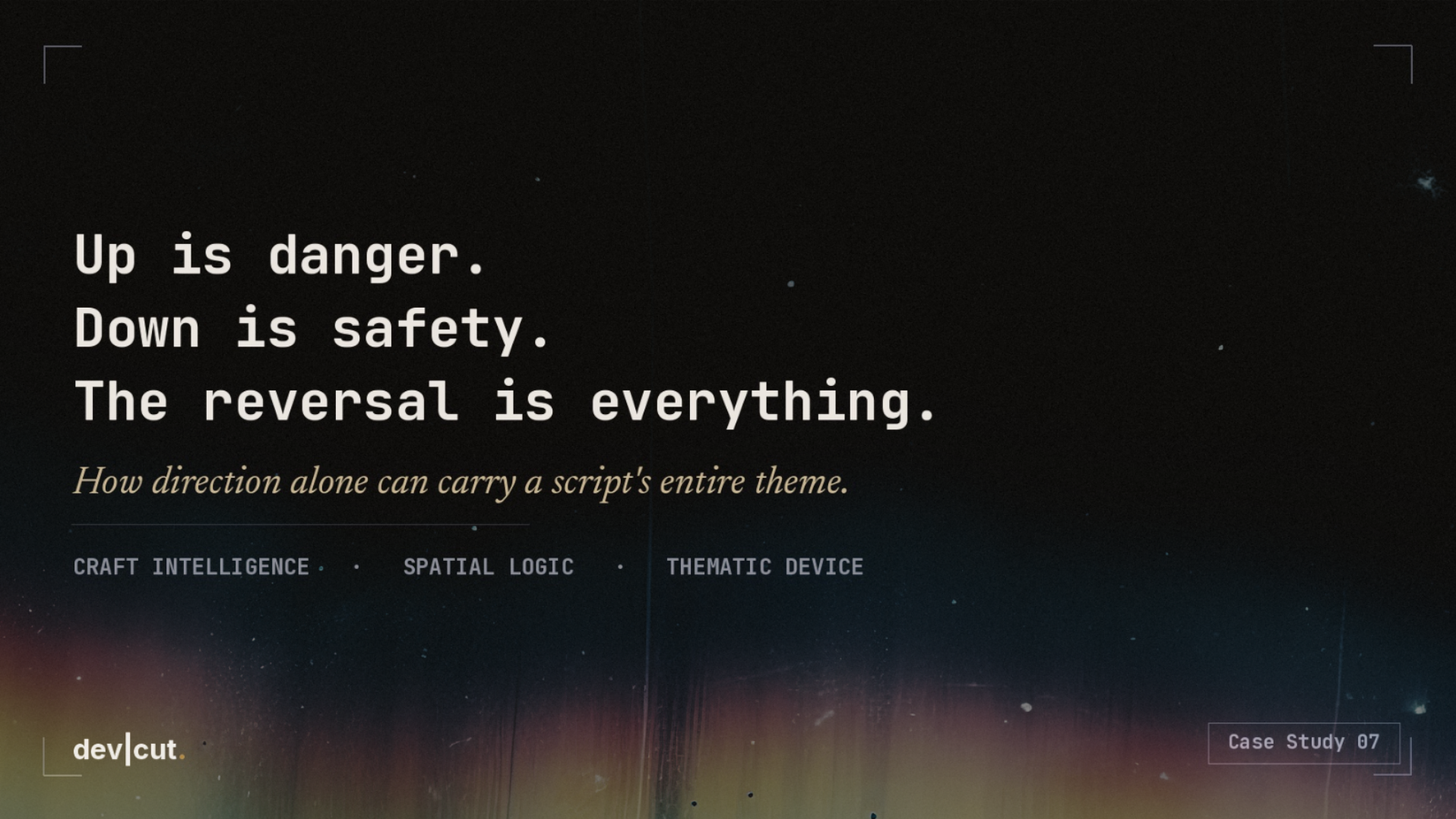
The device. In Canopy, climbing higher means moving closer to danger. Descending means moving closer to safety. That’s a direct inversion of almost every instinct an audience carries in. We’re taught that up is supposed to be hope, up is supposed to be heaven, ascension is supposed to be the reward. This script refuses to give you that. Down is where the safety is. It goes against human nature, which adds tension without ever saying a word.
Nobody explains this. No character turns to another and lays out the metaphor. The inversion just exists, permeating every page, communicated entirely through where people move and why, scene after scene. What you get is the audience feeling it long before they could ever articulate it as a “theme.”
Why it works. The coverage named it directly as one of the script’s clearest strengths: a fresh spatial logic that gives the script a genuinely marketable centerpiece, functioning as both threat and toolkit throughout. That’s a rare thing for a structural device to do. It isn’t just clever, it’s load-bearing. Take it out and the survival mechanics of the story still work, but leave it in and the story is suddenly making an argument about instinct, safety, and what we assume “up” means, without spending a single line of dialogue to do it.
What this says beyond this one script. There’s a lesson to be taken here regardless of what you’re writing. A script’s compelling nature, its thesis, doesn’t have to live in plot or dialogue. Direction can do it. Color can do it. Silence can do it. The instinct to explain a theme out loud is usually the instinct to distrust the audience, and the strongest scripts tend to trust them the most.
Canopy earned a Final Polish verdict from dev|cut. and deservedly so. The coverage confirms the structure is sound, the instincts are strong, and what’s left is refinement, not reconstruction. The spatial inversion at its center is a big part of why.
Want a read this specific on your own script? Founding rates are locked through September 30. See pricing.
[Soon] The story continues… — Brian Hanford, Writer & Founder, dev|cut.™ · devcut.io
← Back to Blog